Found 55 talks archived in Planetary systems

Abstract
Series: XXVIII Canary Islands Winter School of Astrophysics: Solar System Exploration Topic: Exploring the Outer Solar System
Lecture 2: James Webb Space Telescope (JWST) - Characterizing the outer Solar System
In this second lecture, Dr. Stansberry focus in the James Webb Space Telescope (JWST). The speaker gives a detailed description of the characteristis and capabilities of the telescope, as well as the science case for the observations of Solar System objects using the JWST.

Abstract
Series: XXVIII Canary Islands Winter School of Astrophysics: Solar System Exploration
Topic: Origin and Early Evolution of the Solar System
Lecture 1: Our Understanding of the Solar System through Ages.
This is the first lecture of Dr. Crida, where he gives a historic overview on the improvement of our knowledge on the planets and satellites. He also provides some basic concepts related to celestial mechanics in order to properly follow the rest of his lectures.
Abstract
Series: XXVIII Canary Islands Winter School of Astrophysics: Solar System Exploration
Topic: Exploration of the Solar System by the European Space Agency
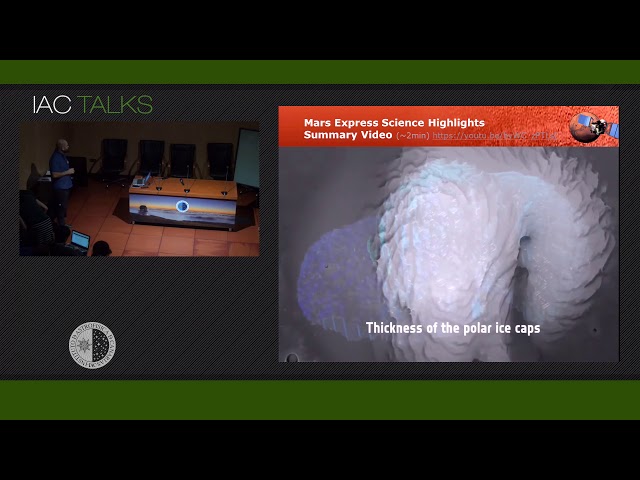
Lecture 2: European exploration of Mars
In this second talk Dr. Cardesín reviews the ESA program for Mars exploration, describing the Mars Express mission and its scientific goals, as well as the ExoMars mission and its current status.
Abstract
Series: XXVIII Canary Islands Winter School of Astrophysics: Solar System Exploration
Topic: Cometary Science and the Rosetta Mission.
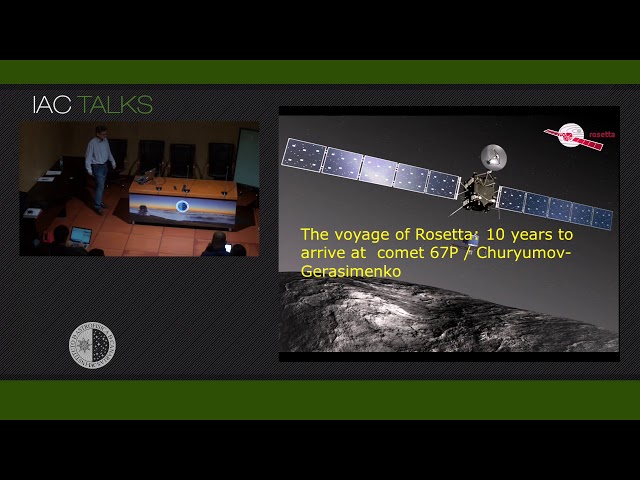
Lecture 2: Rosetta, a voyage to a comet and to our origins.
In this second talk, Dr. Küppers gives an overview of the Rosetta mission, from its launch in 2004 until the end of the mission, in September 2016, only a month before the celebration of this Winter School. The talk includes information on the instruments on-board the spacecraft, the two fly-byes to asteroids Steins and Lutetia, and the results obtained from the observations of comet 67P/C-G.
Abstract
Series: XXVIII Canary Islands Winter School of Astrophysics: Solar System Exploration
Topic: Physical Properties of Asteroid Surfaces
Lecture 2: Novel spectrometric modeling
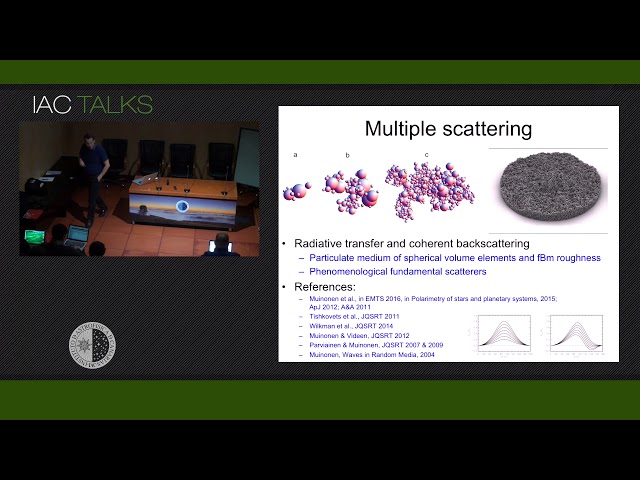
In his second talk, Dr. Muinonen focuses on multiple scattering, describing in detail processes such as the radiative transfer and coherent backscattering (RT-CB), particular cases with incoherent fields, and radiative transfer with reciprocal transactions (R2T2). He also presents very preliminar and recent results obtained by his team at the University of Finland on incoherent backscattering experimetns on millions of spherical particles. In this talk he also revisits space weathering in the context of radiative transfer theory and presents some experiments carried out with olivine.
Abstract
Series: XXVIII Canary Islands Winter School of Astrophysics: Solar System Exploration
Topic: Planetary Atmospheres.
Lecture 2: Radiative transfer, composition, and clouds.
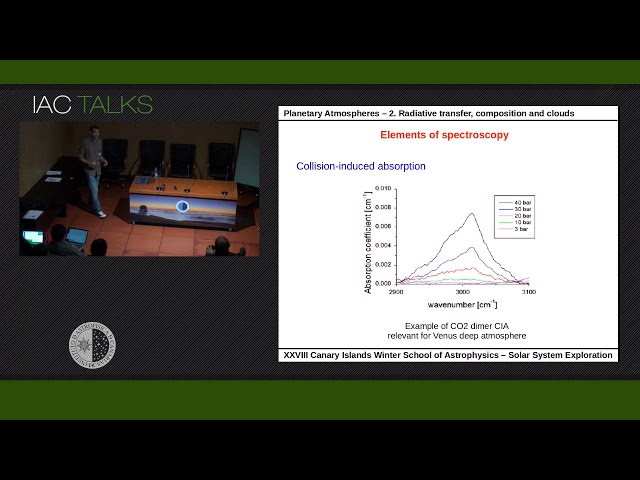
In his second lecture Dr. Lebonnois talks about the processes that take place in the atmosphere of the planets, explaining the energy balance between the different layers, and the interaction with the surface. The generation of spectral lines and bands, the creation of clouds, and the characteristics of temperature profiles are also described with detail.
Abstract
Series: XXVIII Canary Islands Winter School of Astrophysics: Solar System Exploration
Topic: Cometary Science and the Rosetta Mission.
Lecture 1: Comets and the Rosetta mission.
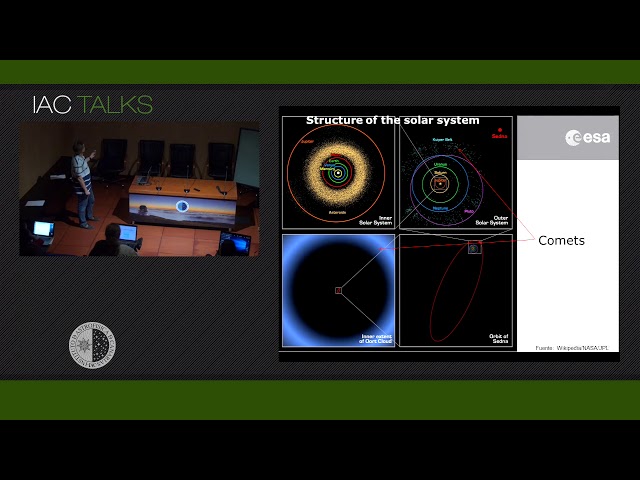
Dr. Küppers gives a general overview on comets in the context of the formation of the Solar System, describing their physical, dynamical, and compositional properties. The speaker describes cometary missions that have been sent before the Rosetta mission and lists some of the most important cometary science questions that are still unsolved or under debated.
Abstract
Series: XXVIII Canary Islands Winter School of Astrophysics: Solar System Exploration
Topic: Physical Properties of Asteroid Surfaces
Lecture 1: Introduction to asteroid UV-VIS-NIR spectrometry
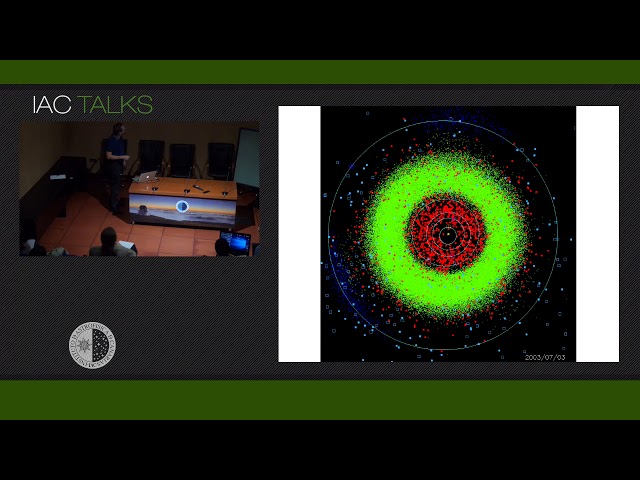
In this first talk, Dr. Muinonen gives an introduction to polarimetry, photometry, and spectropolarimetry techniques and their application to the study of asteroid surfaces. The talk includes a description of the Shkuratov radiative transfer model and the use of Monte Carlo simulations to model radiative transfer for meteorite spectra.
Abstract
Series: XXVIII Canary Islands Winter School of Astrophysics: Solar System Exploration
Topic: Exploring the Outer Solar System
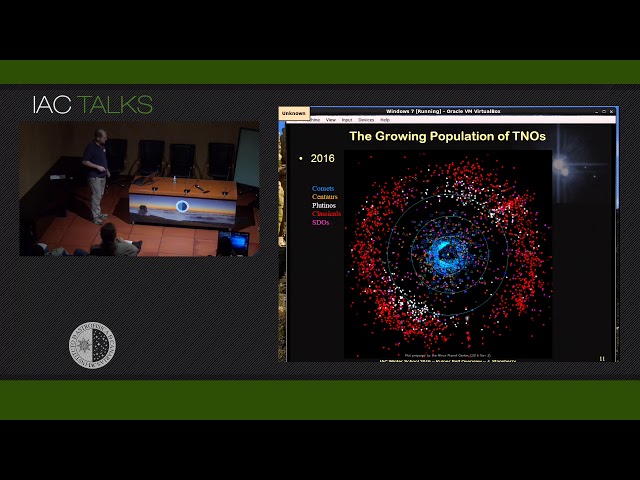
Lecture 1: TNOs: a brief history, dynamical structure, and characteristics of its inhabitants
This first talk is devoted to provide an overview of the current state of the population of minor bodies beyond the orbit of Neptune. A review of the discovery history is given, as well as a description of the physical, compositionsl, and dynamical properties of trans-Neptunian objects (TNOs), Pluto, and the Kuiper belt in general.
Abstract
Series: XXVIII Canary Islands Winter School of Astrophysics: Solar System Exploration
Topic: Planetary Atmospheres.
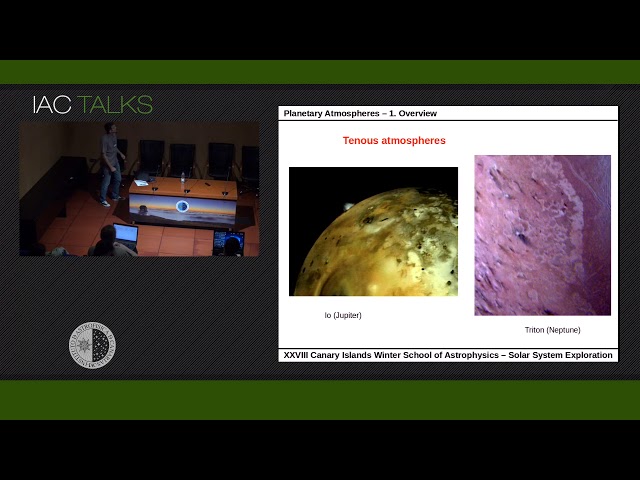
Lecture 1: Overview of planetary atmospheres in the Solar System.
In this lecture Dr. Lebonnois talks about the large diversity of objects that populate our Solar System, gives an overview on the different types of atmospheres that can be found, as well as the atmospheric structures, and ends with an update on the current exploration of planetary atmospheres.
Upcoming talks
- Quantum Simulators for the Cosmos: From Confining Strings to the Early UniverseDr. Enrique Rico OrtegaThursday December 4, 2025 - 10:30 GMT (GTC)
- Colloquium by Junbo ZhangDr. Junbo ZhangThursday December 11, 2025 - 10:30 GMT (Aula)
Recent Colloquia
Recent Talks