Colloquia
Talks given by high profile astronomers and scientists.

Abstract
The rapid progress of quantum technologies—highlighted by recent Nobel Prizes recognizing advances in controlling quantum matter—is reshaping how we investigate the fundamental laws of nature. In this colloquium, I will introduce the concept of quantum machines: platforms such as quantum computers, analog simulators, and engineered networks of photons or ultracold atoms that process information according to the principles of quantum mechanics. These systems are emerging as powerful tools to emulate physical phenomena that were previously inaccessible to theory or experiment. By bridging quantum information science, tensor network methods, and high-energy physics, this work exemplifies how quantum machines are becoming laboratories for exploring exotic phases of matter, the structure of gauge fields, and the processes that shaped the early cosmos. Together, these advances mark the beginning of a new era in which we can engineer, manipulate, and ultimately understand some aspects of the quantum fabric of the universe.
Abstract

Abstract
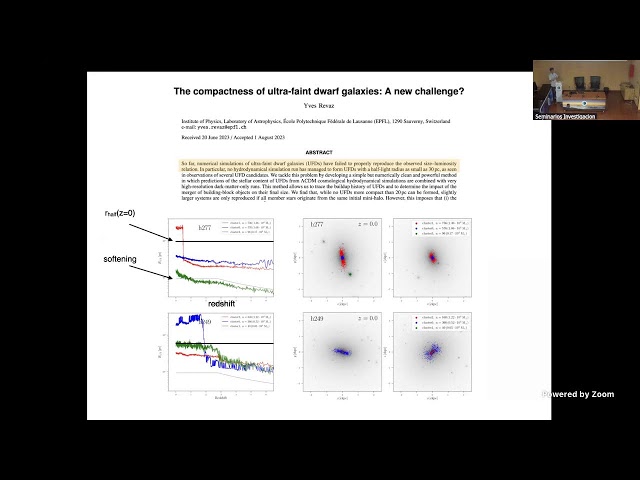
In the past decades, studies of the Milky Way have entered a golden era of large-scale surveys. The Gaia satellite provides precise positions, proper motions, and parallaxes for billions of stars, while ground-based spectroscopic surveys, such as LAMOST, deliver radial velocities and metallicities for nearly ten million stars. In addition, medium- and narrow-band photometric surveys, as well as Gaia’s slitless spectroscopic surveys, provide atmospheric parameters for hundreds of millions of stars. This talk will first summarize our efforts in measuring stellar parameters from these surveys, and then present our work on understanding the assembly history of the Milky Way—particularly its early phase, when the proto-Galaxy formed—and its dark matter distribution, based on the measured parameters of a very large number of stars.
Abstract
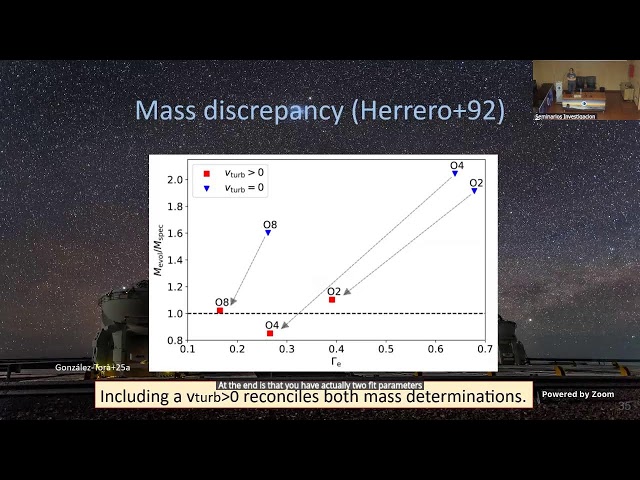
Massive stars play a vital role in shaping the cosmic matter cycle and driving galaxy evolution, chemically enriching their host galaxy through their powerful stellar winds. Understanding the physical processes behind these mass-loss events is key to producing accurate model predictions. Despite its importance, stellar atmosphere modelling poses several challenges. In this talk, we will explore these challenges accross a range of massive stellar types, from OB main-sequence stars to evolved red supergiants and Wolf-Rayets. With these insights, I will further discuss the consequences of mass outflows on stellar evolution and the surrounding environment.
Abstract
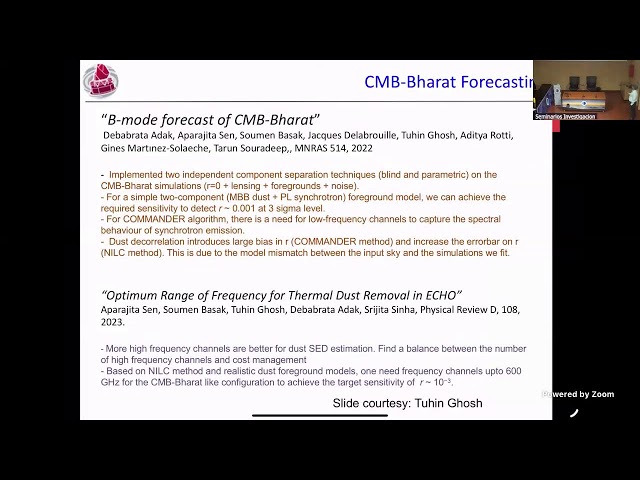
The remarkable success of recent cosmology in pinpointing a consistent concordance model relies on several foundational assumptions, including homogeneity, isotropy of the universe, and scale invariance, among others. Increasingly precise cosmological observations, such as the exquisite measurements of the CMB sky from the ESA Planck space mission, have opened up the possibility of robust, independent tests of these assumptions. I will present key results from my research programs on this theme and review the current status of the research.
Abstract
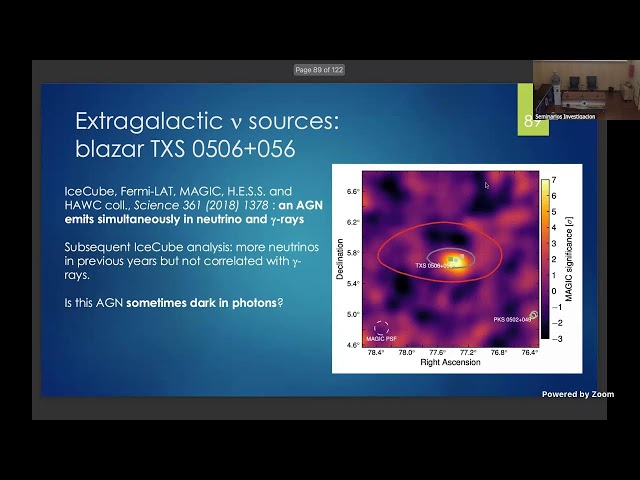
During the last few decades, we've begun to glimpse the universe not just with photons, but also with other messengers like cosmic rays, neutrinos, and even gravitational waves. I will show why photons, cosmic rays, and neutrinos are fundamentally interconnected—as dark matter may also be—and why very-high-energy gamma rays are a key domain in multi-messenger astronomy. I'll emphasize the role of a few key experiments in the Canary Islands in this field, and discuss some of the latest results that are opening new scientific prospects for the upcoming generation of detectors.
Abstract
Abstract
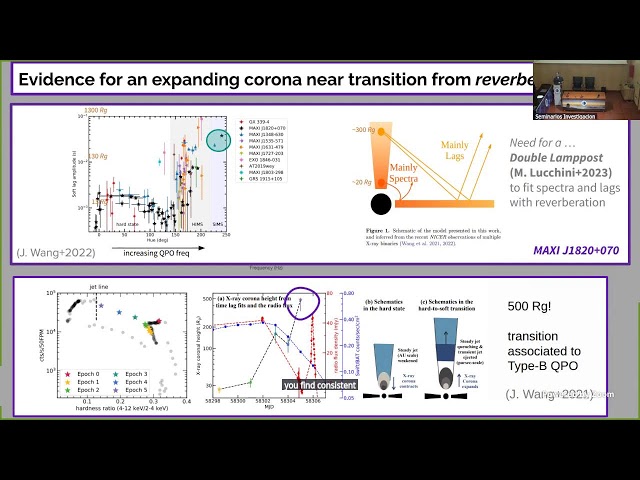
X-ray binaries (XRBs) are binary systems where a compact object, either a black hole or a neutron star, accretes matter from a stellar companion via an accretion disc. As this material spirals in, it heats up and emits X-rays, typically exhibiting transient outburst behaviour.
During these outbursts, XRBs often transition between hard states (dominated by inverse Comptonization in a hot-electron corona) and soft states (where thermal emission from the disc prevails). In the hard states, XRBs display strong variability across multiple timescales, frequently featuring quasi-periodic oscillations (QPOs).
To probe these fast dynamics, we employ spectral-timing Fourier techniques, which allow us to infer the geometry of the accretion flow and the mechanisms governing radiation propagation in the vicinity of the compact object, crucial information not directly accessible through the stationary spectrum alone.
In this talk, I will delve into the spectral-timing phenomenology of XRBs and present the insights gained from applying a time-dependent Comptonization model, aiming to deepen our understanding of the state transition and outburst evolution in these complex systems.
Abstract
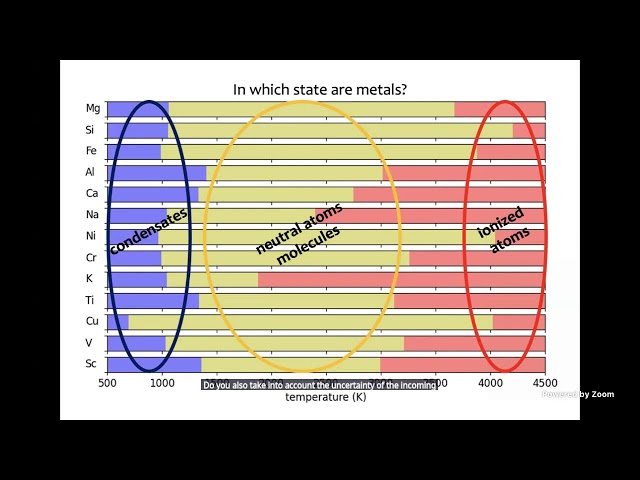
In the last years, ground-based and space observations are bringing a wealth of constraints on the chemical composition of exoplanet atmospheres. Chemical models are particularly useful because they provide the theoretical framework to interpret these observations and make new predictions. I will describe how such models are built and discuss some recent efforts aimed to provide a more accurate description of the atmospheric composition, with emphasis on the mutual influence of temperature and disequilibrium composition, the quantification of abundance uncertainties, and the variation of the composition as a function of longitude.
Abstract
I will present ATLAS-Teide, the new robotic facility of the Asteroid Terrestrial-impact Last Alert System (ATLAS), built and installed by the IAC at the Teide Observatory in mid-January 2025. ATLAS-Teide is part of the IACs Strategic Plan of the Canary Observatories, supported by projects EQC2021-007122-P and ICT2022-007828, both funded by the European Union – NextGenerationEU. The system operates within the global ATLAS network under a collaborative agreement between the IAC and the University of Hawaii, covering both operations and scientific exploitation.
ATLAS is one of the most successful planetary-defense early-warning projects. The network currently includes four 50-cm Wright–Schmidt telescopes in Hawaii, Chile, and South Africa. Each unit surveys roughly a quarter of the night sky, imaging each field four times per night to V ~ 19.5, and is designed to detect ~20 m impactors days in advance and ~100 m objects weeks ahead.
ATLAS-Teide is the fifth ATLAS unit and introduces a cost-effective, modular design based on commercial off-the-shelf components. Each module combines four Celestron RASA 11 telescopes on a PlaneWave L-550 direct-drive equatorial mount with QHY600PRO CMOS cameras sharing a common field. A single module delivers the performance of a 56-cm aperture with a 7.5 deg2 field of view and 1.26 arcsec/pixel scale. The full facility comprises four modules in a roll-off-roof building, replicating the survey capability of existing ATLAS units-covering ~6000 deg2 four times per night with 30-second exposures to V ≈ 20.2. ATLAS-Teide is already providing high-cadence observations, reporting astrometry for thousands of asteroids nightly, discovering new NEAs and transients (including supernovae). I will also present first scientific results from the facility.
Upcoming talks
- High-accuracy spectral modeling and chemical abundances for the oldest starsDr. Junbo ZhangThursday December 11, 2025 - 10:30 GMT (Aula)
Recent Colloquia
Recent Talks