Found 19 talks width keyword spectroscopy
Abstract
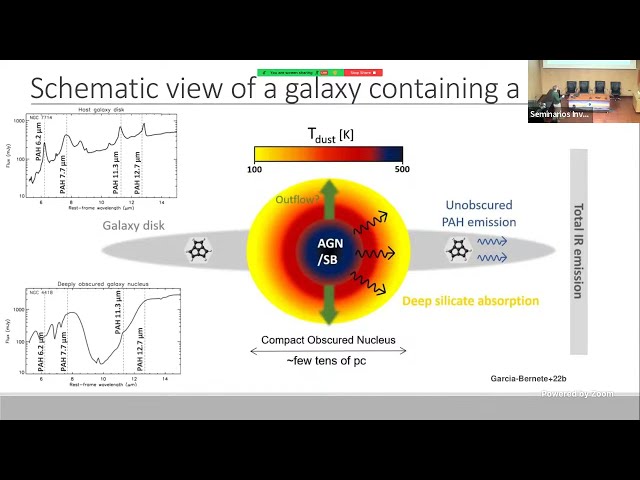
Finally, I will summarise our ongoing JWST work within the GATOS (Galactic Activity, Torus and Outflow Survey) collaboration. In particular, I will focus on our recent study about the survival of PAH molecules in AGN-driven outflows.
Abstract
The new generation of spectrometers designed for extreme precision radial velocities enable correspondingly precise stellar spectroscopy. It is now fruitful to theoretically explore what the information content would be if stellar spectra could be studied with spectral resolutions of a million or more, and to deduce what signatures remain at lower resolutions. Hydrodynamic models of stellar photospheres predict how line profiles shapes, asymmetries, and convective wavelength shifts vary from disk center to limb. Corresponding high-resolution spectroscopy across spatially resolved stellar disks is now practical using differential observations during exoplanet transits, thus enabling the testing of such models. A most demanding task is to understand and to model spectral microvariability toward the radial-velocity detection of also low-mass planets in Earth-like orbits around solar-type stars. Observations of the Sun-as-a-star with extreme precision spectrometers now permit searches for spectral-line modulations on the level of a part in a thousand or less, feasible to test against hydrodynamic models of various solar features.
Abstract
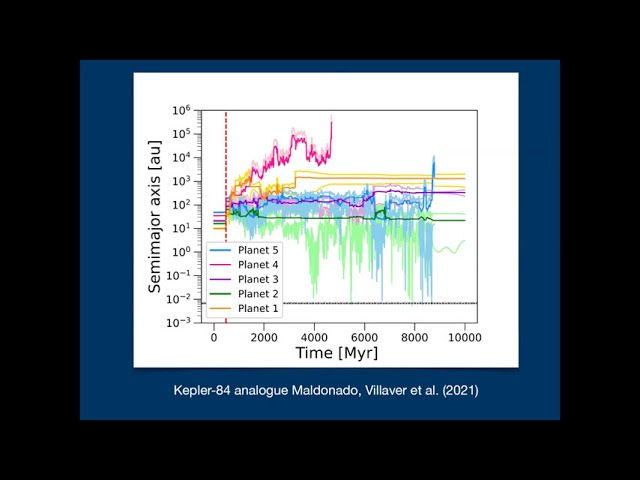
Planetary systems have been found systematically orbiting main sequence stars and red giants. But the detection of planets per se during the white dwarf phase has been more elusive with only 3 systems. We have, however, ample indirect evidence of the existence of planetary debris around these systems in the form of material acreted onto the white dwarf, disks and even planetesimals. In this talk, I will review how we can put the pieces together: how we can reconcile what we see in white dwarfs with what we can infer regarding the evolution of planetary systems from the main sequence phase.
Abstract
Automatización del POTEC
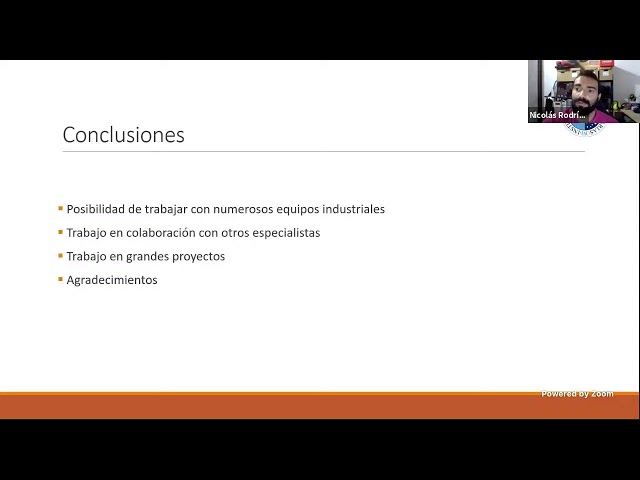
Explicación del problema de automatización del criostato de pruebas para la preóptica de Harmoni. Integración de diferentes protocolos de comunicación mediante el uso de lenguajes de alto nivel y un manejo de los errores que posibilite su integración dentro de un proceso industrial robusto acelerando el tiempo de prototipado y testeo. Uso de Python para la adquisición de datos y la supervisión del proceso en tiempo de ejecución.
Desarrollo de un sistema de medida optoelectrónico para la caracterización de fotodetectores basado en un monocromador
Creación de una aplicación Python para el control de un sistema óptico y la toma de datos de dos picoamperímetros conectados a sendos fotodiodos que miden la intensidad de la radiación emitida. Esto nos servirá para la caracterización del fotodetectores
Tema: Seminario de Instrumentación: Presentaciones Becarios de Verano
Hora: 17 sept. 2021 12:00 p. m. Atlantic/Canary
Unirse a la reunión Zoom
https://rediris.zoom.us/j/81452070054
Youtube
https://youtu.be/7GSWv6mbQlg
Abstract
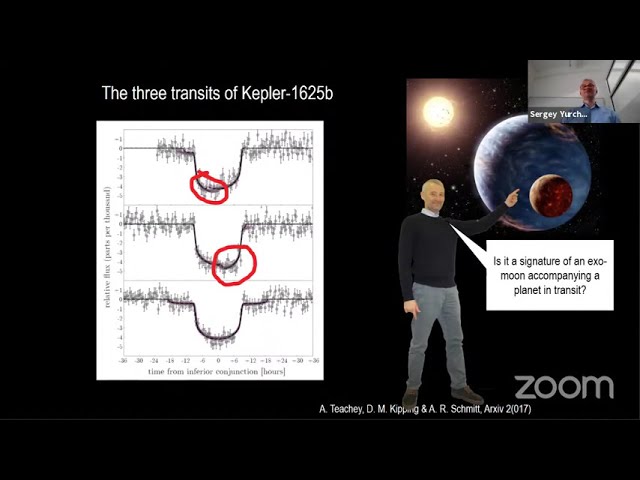
The ExoMol project (www.exomol.com) provides comprehensive spectroscopic data (line lists) for the study of atmospheres of exoplanets and other hot bodies. These line lists serve as input for models of radiative transport through hot atmospheres and are useful for a variety of terrestrial applications. The basic form of the database is extensive line lists; these are supplemented with partition functions, state lifetimes, cooling functions, Landé g-factors, temperature-dependent cross sections, opacities, k-coefficients and pressure broadening parameters. Currently containing 80 molecules and 190 isotopologues totaling over 700 billion transitions, the database covers infrared, visible and UV wavelengths. The field of the HR spectroscopy of exoplanets is growing extremely fast and urgently demands molecular data of high precision. Failure to detect molecules in atmospheres of exoplanets is often attributed to the lack of the underlying quality of
the line positions. These developments have led us to begin a systematic attempt to improve the accuracy of the line positions for the line lists contained in the database. Our new ExoMolHD project aims to provide comprehensive line lists to facilitate their use in characterization of exoplanets using high resolution Doppler shift spectroscopy. Progress on this objective will be presented.
Abstract
At present, our understanding of the formation history of the MW is limited due to the complexity of observing the imprints of accretion events and of reproducing them in numerical simulations. Moreover, though being the only galaxy, in which the Galactic potential can be probed in detail, the distribution of mass in the MW, and hence of the dark matter, is poorly constraint, especially at large distances. In addition, the MW is not isolated, and it has recently been suggested that the infall of the LMC can induce a perturbation in the stellar and dark matter distribution of the MW. As a consequence, the details of the formation history of our Galaxy are still unknown, such as the number of accretion events, the mass of the accreted galaxies, and the epoch of these events. Yet this information is crucial to understand our environment and to constrain the theoretical models and simulations that try to reproduce it.
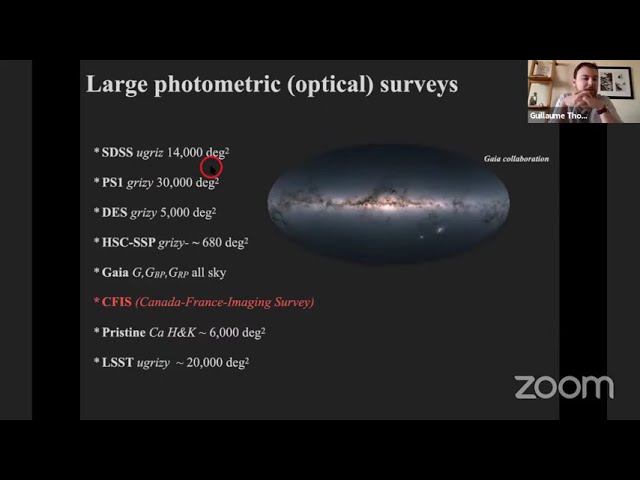
One of the major challenges of the field is that a tremendous number of multi-aspect (astrometric, photometric and spectroscopic) observations at significant depth is required to study the morphology, the kinematics and the chemistry of the outskirts of our Galaxy, where are located the signatures of these events. Hopefully, the advent of recent and incoming complementary large surveys, such as the European Gaia mission, UNIONS (Ultraviolet Near Infrared Optical Northern Survey), Pristine, Pan-STARRS (PS), WEAVE or LSST (Legacy Survey of Space and Time), is offering a new global point of view on our Galaxy’s halo, allowing us to precisely probe the Galactic potential our the MW, and to retrace itsaccretion history.
In this talk I will present recent works that have been conducted to better catarerized our Galaxy and its history with some of the existing surveys mentioned above. In addition, I will present the major improvement that will bring this new generation of large, multi-aspect surveys, to study both our Galactic history, as well as the fundamental nature of the dark matter.
Abstract
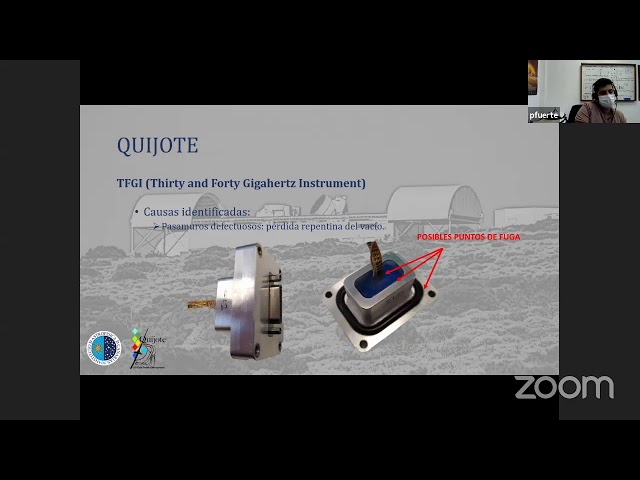
Durante este seminario se hará un recorrido sobre la instrumentación dentro del proyecto QUIJOTE, desde de los instrumentos ya existentes y su problemática hasta el estado actual de los instrumentos de nueva generación y los posibles desarrollos a futuro.
Abstract
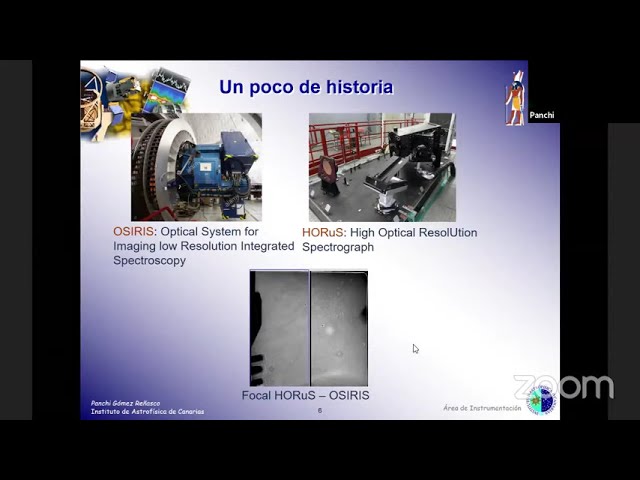
HORUS (High ResolUtion Spectrograph) es un espectrógrafo de alta resolución, instrumento visitante en GTC y disponible para la comunicad científica desde prinicipios de 2019. Instalado en la plataforma Nasmyth B, detrás de OSIRIS, comparte foco con él. En esta charla se describe su software de control, resaltando la implementación realizada para ser un instrumento visitante de GTC y cómo se ha resuelto el problema del apuntado de un objeto.
Abstract
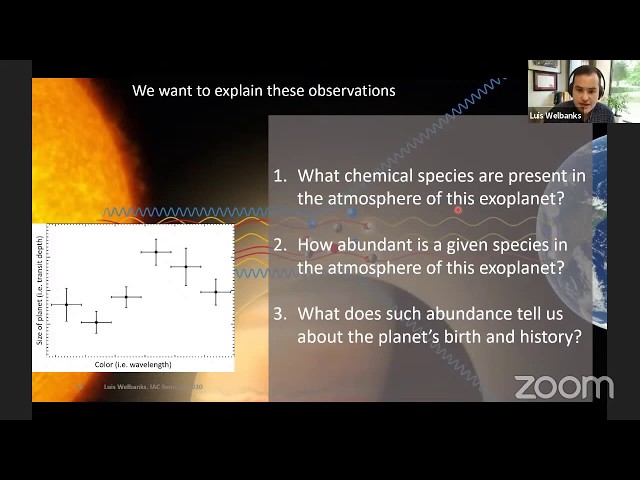
Atmospheric compositions can provide powerful diagnostics of formation and migration histories of planetary systems. In this talk, I will present the results of our latest survey of atmospheric compositions focused on atmospheric abundances of H2O, Na, and K. We employ a sample of 19 exoplanets spanning from cool mini-Neptunes to hot Jupiters, with equilibrium temperatures between ~300 and 2700 K. We employ the latest transmission spectra, new H2 broadened opacities of Na and K, and homogeneous Bayesian retrievals. We confirm detections of H2O in 14 planets and detections of Na and K in 6 planets each. Among our sample, we find a mass-metallicity trend of increasing H2O abundances with decreasing mass, spanning generally substellar values for gas giants and stellar/superstellar for Neptunes and mini-Neptunes. However, the overall trend in H2O abundances, is significantly lower than the mass-metallicity relation for carbon in the solar system giant planets and similar predictions for exoplanets. On the other hand, the Na and K abundances for the gas giants are stellar or superstellar, consistent with each other, and generally consistent with the solar system metallicity trend. The H2O abundances in hot gas giants are likely due to low oxygen abundances relative to other elements rather than low overall metallicities, and provide new constraints on their formation mechanisms. Our results show that the differing trends in the abundances of species argue against the use of chemical equilibrium models with metallicity as one free parameter in atmospheric retrievals, as different elements can be differently enhanced.
Zoom link: https://rediris.zoom.us/j/92734027825
Abstract
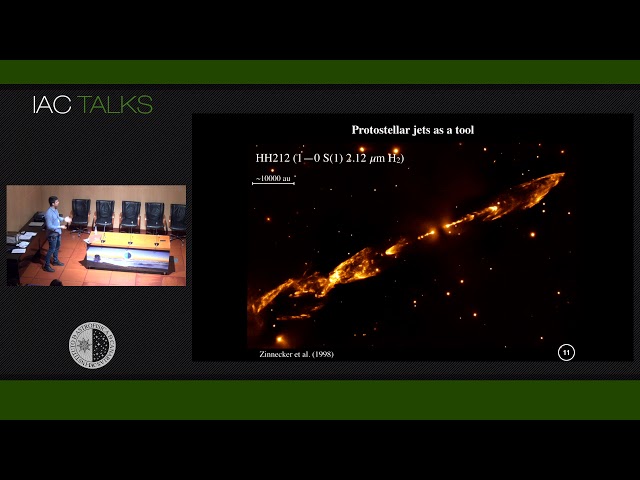
In contrast with low-mass young stellar objects (LMYSOs), very little is known about high-mass YSOs (HMYSOs). Latest results indicate that HMYSOs might be born in a similar way as LMYSOs, i.e., through disc accretion and jet ejection. HMYSOs are deeply embedded in their parent cloud and are at kpc distance, hindering direct imaging of their accretion discs. Jets then become essential to understand the physical properties of the central source. High-resolution near-IR VLT instruments allow us to study HMYSO jets down to au scales and compare them with the low-mass regime. In this talk, I will present VLT/ISAAC, SINFONI, and CRIRES results on two HMYSOs. Spectro-astrometry is used to retrieve information about the jet down to mas scales (~tens of au at kpc distance). High-resolution spectroscopy allows us to retrieve the kinematic and dynamic properties of the massive jets. Additionally, HST imaging in the [FeII] shows the jet structure close to the star. Finally, these properties are compared with low-mass jets, suggesting that the formation of HMYSOs might be a scaled-up version of their low-mass counterparts, and their properties scale with mass.
« Newer 1 | 2 Older » Last >>
Próximas charlas
- Quantum Simulators for the Cosmos: From Confining Strings to the Early UniverseDr. Enrique Rico OrtegaThursday December 4, 2025 - 10:30 GMT (GTC)
- Colloquium by Junbo ZhangDr. Junbo ZhangThursday December 11, 2025 - 10:30 GMT (Aula)
Últimos Coloquios

Últimas charlas