Found 22 talks width keyword Deep Learning

Abstract
First in the lecture series on deep learning for astronomy. This series is designed to provide clear and accessible introductions to key deep learning techniques, with examples of their applications to astronomical data and research. In the first session we shall provide a brief history of deep learning and introduce the intuition and basic math behind NNs, together with examples related to data fitting with basic NN (slides and code provided in .https://github.com/cwestend/IACDEEP_introNN/)
Abstract
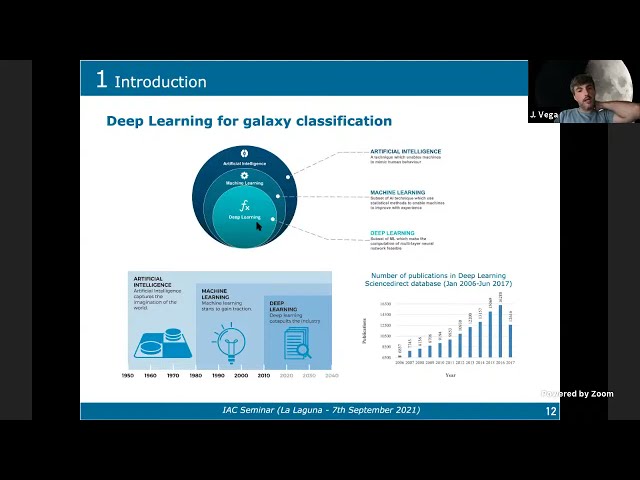
Galaxy morphologies are one of the key diagnostics of galaxy evolutionary tracks, but visual classifications are extremely time-consuming. The sheer size of Big Data surveys, containing millions of galaxies, make this approach completely impractical. Deep Learning (DL) algorithms, where no image pre-processing is required, have already come to the rescue for image analysis of large data surveys. In this seminar, I will present the largest multi-band catalog of automated galaxy morphologies to date containing morphological classifications of ∼27 million galaxies from the Dark Energy Survey. The classification separates: (a) early-type galaxies (ETGs) from late-types (LTGs); and (b) face-on galaxies from edge-on. These classifications have been obtained using a supervised DL algorithm. Our Convolutional Neural Networks (CNNs) are trained on a small subset of DES objects with previously known classifications, but hese typically have mr < 17.7 mag. We overcome the lack ofa training sample by modeling fainter objects up to mr < 21.5 mag, i.e., by simulating what thebrighter objects with well-determined classifications would look like if they were at higher redshifts.The CNNs reach a 97% accuracy to mr < 21.5 on their training sets, suggesting that they are ableto recover features more accurately than the human eye. We obtain secure classifications for 87%and 73% of the catalog for the ETG vs. LTG and edge-on vs. face-on models, respectively.
Abstract
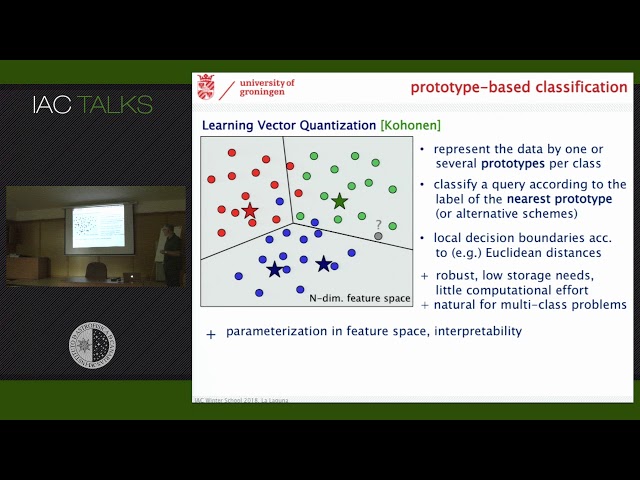
Series: XXX Canary Islands Winter School of Astrophysics: Big Data in Astronomy
Topic: Supervised learning: classification and regression
Lecture 4
Abstract
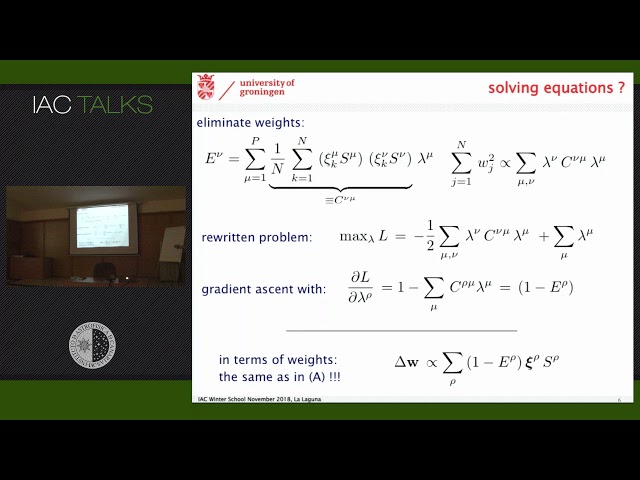
Series: XXX Canary Islands Winter School of Astrophysics: Big Data in Astronomy
Topic: Supervised learning: classification and regression
Lecture 3
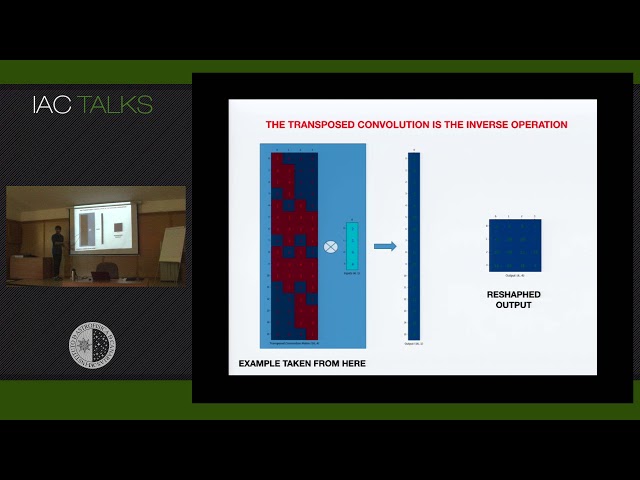
Abstract
Series: XXX Canary Islands Winter School of Astrophysics: Big Data in Astronomy
Topic: Deep learning
Lecture 4
Abstract
Series: XXX Canary Islands Winter School of Astrophysics: Big Data in Astronomy
Topic: Data challenges and solutions in forthcoming surveys
Lecture 4
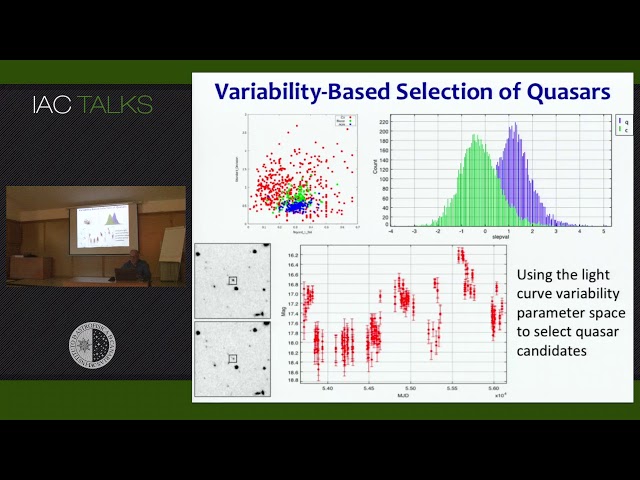
Abstract
Series: XXX Canary Islands Winter School of Astrophysics: Big Data in Astronomy
Topic: General overview on the use of machine learning techniques in astronomy
Lecture 4
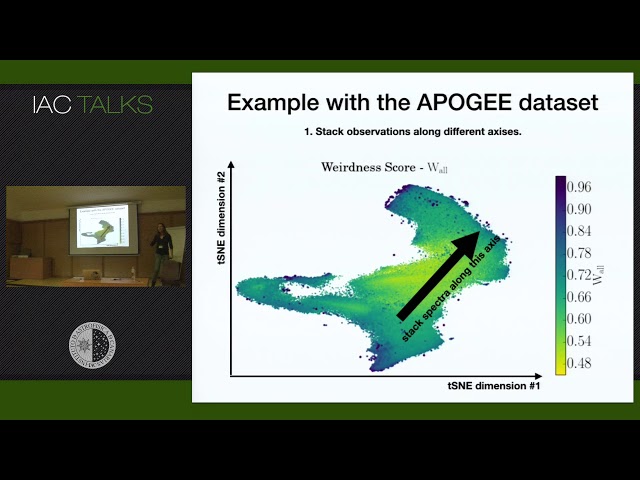
Abstract
Series: XXX Canary Islands Winter School of Astrophysics: Big Data in Astronomy
Topic: Machine learning methods for non-supervised classification and dimension reduction techniques
Lecture 4
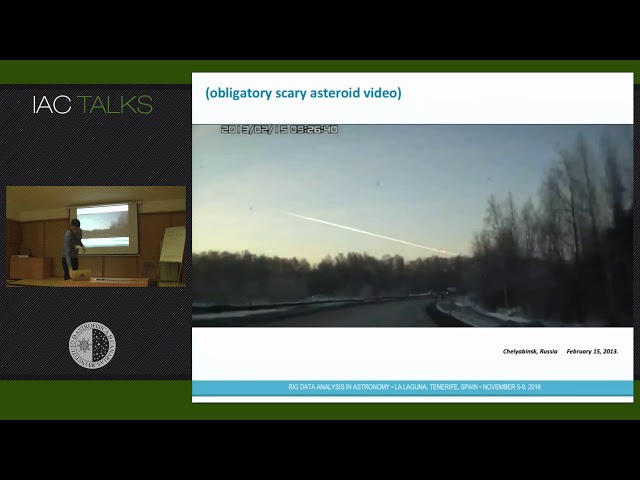
Abstract
Series: XXX Canary Islands Winter School of Astrophysics: Big Data in Astronomy
Topic: Data challenges and solutions in forthcoming surveys
Lecture 3
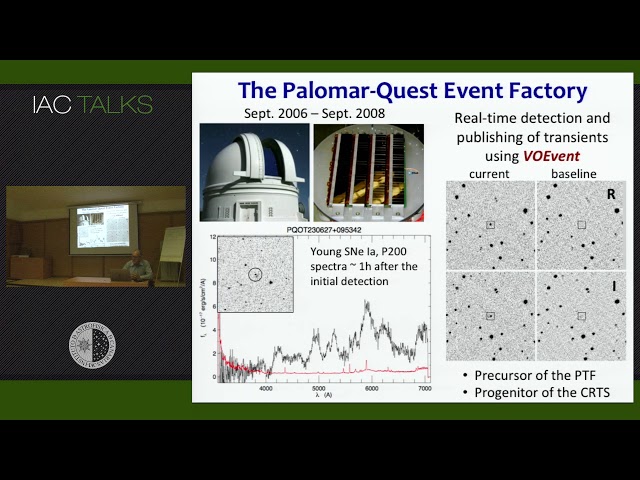
Abstract
Series: XXX Canary Islands Winter School of Astrophysics: Big Data in Astronomy
Topic: General overview on the use of machine learning techniques in astronomy
Lecture 3
« Newer 1 | 2 | 3 Older » Last >>
Upcoming talks
- High-accuracy spectral modeling and chemical abundances for the oldest starsDr. Junbo ZhangThursday December 11, 2025 - 10:30 GMT (Aula)
Recent Colloquia
Recent Talks